Views: 0 Author: Site Editor Publish Time: 2026-10-20 Origin: Site
You face major capital expenses when upgrading or establishing a filter bag production facility. You must find equipment balancing high initial output and long-term reliability. Buyers often fixate on the initial sticker price of a Filter Bag Sewing Machine. They frequently ignore crucial factors like material compatibility and automation needs. Handling difficult fabrics like PTFE or woven fiberglass requires highly specialized setups. Overlooking these specific material requirements causes severe production delays and wastes your budget.
This guide breaks down the primary pricing tiers and evaluates different procurement channels. We provide a practical framework to help you confidently shortlist equipment. You will learn how to choose machinery matching your facility's exact compliance standards. We outline actionable steps to evaluate vendors and ensure seam integrity. By the end, you will make a highly informed purchasing decision for your production floor. Taking the time to understand these elements protects your investment.
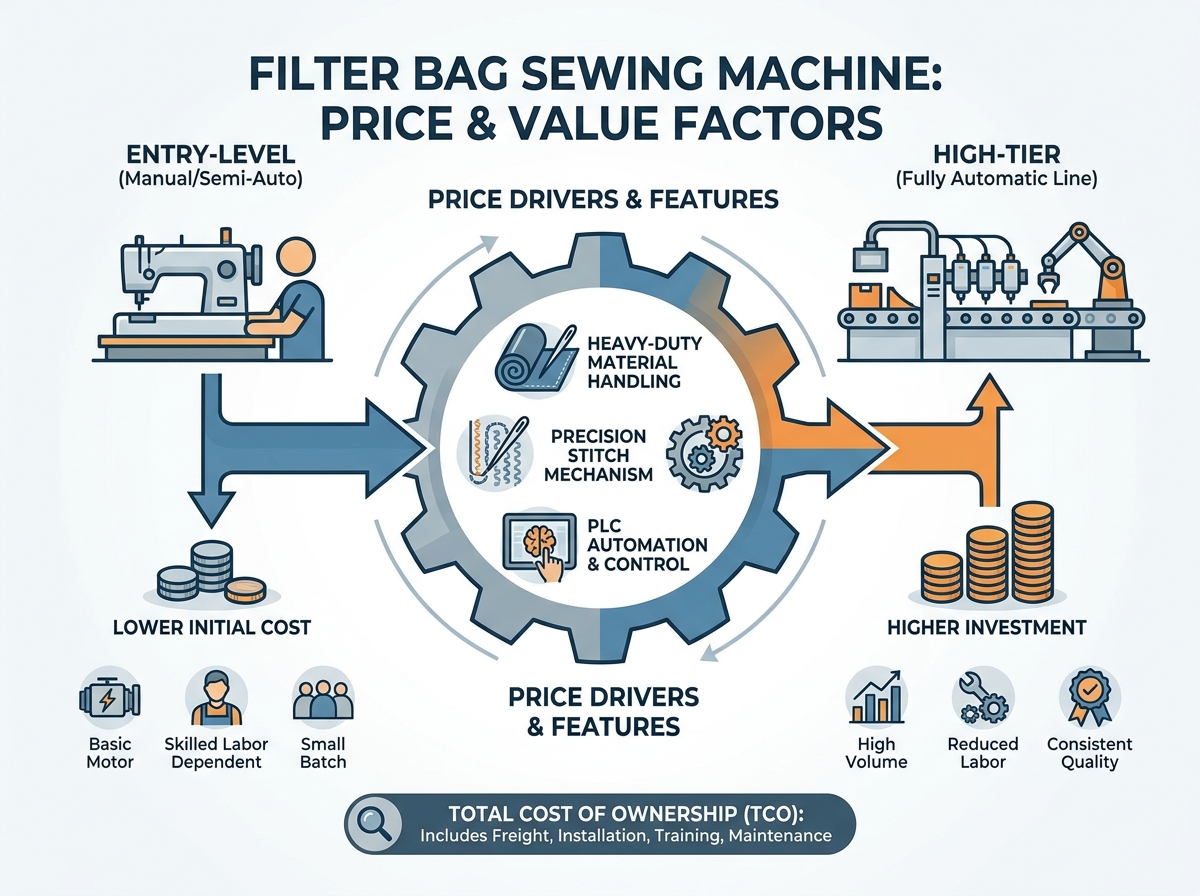
Pricing Variations: Costs range from low-tier manual units to high-tier fully automatic production lines; exact pricing depends heavily on the degree of automation and stitch specifications.
Hidden Costs: Freight, installation, operator training, and consumable parts (needles, specialized threads) can add 15-30% to the initial machinery cost.
Sourcing Strategy: Direct-from-manufacturer purchases offer better customization and warranty support compared to third-party marketplaces or used equipment platforms.
Evaluation Priority: Success depends less on brand name and more on verifiable sample testing, stitch consistency (preventing dust/liquid bypass), and after-sales service agreements.
Aligning your production volume requirements with the correct machine category prevents over-capitalization. You want to avoid creating operational bottlenecks on your factory floor. We break down the main pricing tiers below to guide your budget planning. Choosing the wrong tier limits your growth or wastes valuable capital.
Table 1: Filter Bag Production Machinery Pricing Overview
Machine Type | Best For | Primary Cost Drivers | Labor Dependency |
|---|---|---|---|
Manual / Semi-Automatic | Small-batch, custom sizing, replacements | Motor capacity, single/double needle setup | High (requires skilled operators) |
Fully Automatic Lines | High-volume OEMs, large industrial suppliers | Auto-feeding, PLCs, integrated cutting modules | Low (mostly supervisory roles) |
You should choose manual units for custom or localized production. Operators feed materials by hand into these entry-level machines. Cost drivers include single versus double needle configurations. Basic motor capacities and manual cutting mechanisms also dictate the price. These units fit perfectly in small replacement facilities handling diverse filter dimensions.
Trade-offs: You benefit from a much lower initial capital expenditure. However, you rely heavily on skilled operator labor to maintain quality. You face a higher risk of inconsistent stitch tension. Human error often leads to uneven seams and material waste. We recommend these units only when daily volume remains very low or highly customized.
These extensive lines serve high-volume OEM manufacturers and large industrial suppliers. They transform raw fabric rolls into finished bags automatically. Cost drivers include automated feeding and continuous stitching systems. Auto-cutting tools and integrated hot-melt modules increase the price significantly. The complex engineering required for component synchronization commands a premium.
Trade-offs: You must make a substantial upfront investment to acquire them. The line requires highly standardized raw materials and dedicated floor space. However, it drastically reduces your per-unit labor costs. You achieve much higher consistency across thousands of manufactured units. Automated systems offer the best path to scaling your enterprise efficiently.
We must justify the cost of premium features based on operational efficiency. Product compliance also drives these high-end specifications. You cannot afford to cut corners on core mechanical components.
Abrasive fabrics require highly specialized material handling components. You need needle cooling systems and specialized walking feet. These parts manage heavy materials like woven fiberglass, Nomex, and PTFE. Standard industrial components fail quickly when processing these tough fibers.
Inadequate material handling leads directly to rapid needle breakage. It causes micro-tears in the delicate filter media. Damaged media will fail strict emission compliance standards. You must invest in robust handling features to ensure environmental compliance.
Best Practices for Material Handling:
Always test your thickest media on the proposed machine before buying.
Request pneumatic presser feet for better downward pressure distribution.
Install dedicated needle cooling devices to prevent synthetic thread melting.
Stitch complexity heavily influences the machine's final price tag. You will encounter three-needle six-thread setups alongside standard single-needle lockstitch designs. A heavy-duty Filter Bag Sewing Machine often uses synchronized pullers. These specialized components guarantee smooth, uninterrupted fabric feeding.
These precision pullers ensure absolute seam integrity under operational stress. Liquid or dust filtration environments put immense pressure on these seams. Weak stitches bypass fine particles and ruin the filter's effectiveness. Precision pullers prevent fabric slipping and ensure uniform stitch density from top to bottom.
Modern machines rely heavily on advanced Programmable Logic Controllers (PLCs). You interact directly through intuitive touchscreen interfaces. Operators easily set programmable stitch lengths and run automatic fault detection. These electronic brains control every moving mechanical part of the entire line.
These electronic features add noticeably to the base price. However, they drastically reduce raw material waste during initial setup. They also cut down diagnostic downtime when errors inevitably occur. We recommend PLCs for any facility targeting high daily output. The digital oversight pays for itself rapidly through significantly reduced scrap rates.
Key Automation Features to Request:
Multi-language touchscreen interfaces supporting diverse factory operator teams.
Real-time thread breakage sensors preventing long, wasted production runs.
Automated tension adjustments compensating instantly for variable media thickness.
You must move beyond the invoice price to calculate your actual deployment budget. We outline the hidden operational costs you will encounter during installation. Planning for these expenses prevents sudden budget shortfalls and delayed launches.
Shipping heavy industrial machinery internationally involves highly complex logistics. You must choose between Less than Container Load (LCL) and Full Container Load (FCL). FCL offers better physical protection but costs more upfront. Heavy machinery requires secure lashing inside the container to prevent transit damage.
You must also budget for regional customs duties and border taxes. Buying from overseas B2B wholesale markets triggers mandatory import fees. We strongly recommend hiring a licensed customs broker to prevent port delays. Port storage fees accumulate rapidly if your import paperwork remains incomplete.
You must verify your supplier's installation policies before finalizing the purchase contract. Do they offer on-site commissioning, or only remote video support? Remote support saves money initially but increases your internal setup time. Complex automatic lines usually require seasoned factory technicians on site.
Machine operators require time to learn new automated systems safely. You must budget for production downtime during this critical operational learning curve. Poorly trained staff will damage costly materials and slow down your overall return.
Common Training Mistakes to Avoid:
Rushing the calibration phase just to meet aggressive production targets.
Failing to translate complex digital manuals into the local operator language.
Skipping routine maintenance tutorials during the final supplier handover process.
You need a steady, reliable supply of spare parts to maintain production. Check the availability of proprietary versus universal spare parts. You will regularly replace loopers, customized folders, and specialized sewing thread. Using universal parts keeps your ongoing supply costs much lower over time.
Assume a 5-10% annual maintenance cost relative to the initial purchase price. Build this overhead directly into your annual factory operating budget. Standardizing your consumable supply chain prevents sudden operational halts. Reliable suppliers gladly provide detailed spare parts lists upon request.
You face different risks and rewards across various machinery sourcing platforms. We analyze the three primary procurement categories below. Your choice dictates your warranty coverage and long-term support level.
Buying directly from a factory offers maximum equipment customization. You can tailor the machine exactly to specific bag diameters and lengths. You also secure a direct warranty and vital Factory Acceptance Testing (FAT). To research capabilities thoroughly, review the manufacturing company background before placing your order.
The primary drawback remains the notably longer delivery lead time. You must wait for the actual manufacturing phase and international shipping. Custom engineering inherently takes longer than shipping standard stock units.
Local distributors keep popular machinery models in stock locally. You benefit from much faster delivery and immediate local language support. They also offer easier installation coordination directly on your factory floor. They expertly handle the complex import logistics on your behalf.
However, distributors apply a significant financial markup on factory prices. You also face potential limitations regarding specific custom configurations. They mostly sell standardized, off-the-shelf equipment setups. You might have to compromise on certain specialized production features.
Used platforms offer immediate availability for standard bag-making machines. You benefit from a significantly lower upfront capital expenditure. This procurement channel helps small shops start basic operations very quickly.
Unfortunately, you receive absolutely zero warranty protection. You assume unknown wear-and-tear on highly critical timing components. You also face a high risk of dealing with obsolete, discontinued replacement parts. We strongly advise against used automatic lines for continuous, high-volume production.
Procurement officers need a practical framework to validate vendor claims properly. Follow these actionable steps to verify equipment capability rigorously. Do not rely solely on glossy marketing brochures or digital catalogs.
Never buy a machine without running a physical proof of concept first. Send your own fabric and specialized thread directly to the manufacturer. Ask them to perform a continuous, unedited video-recorded test run. This process proves their machine actually handles your specific materials.
Inspect the returned physical sample very carefully upon arrival. Check the overall seam strength and look closely for needle-hole elongation. Stretched needle holes indicate improper material feeding and guarantee future filtration bypass failures.
You must establish clear Service Level Agreement (SLA) expectations early on. Look for precise documentation outlining all warranty coverage details. Ensure you understand exactly what is covered, like motors and PLCs. Vague warranties often lead to costly, frustrating disputes later.
Distinguish warranty parts clearly from standard wear parts like needles and belts. Reliable manufacturers provide comprehensive maintenance services to support your facility post-purchase. They should offer highly predictable response times for technical troubleshooting.
Industrial machinery must strictly meet your local electrical safety standards. Ensure the equipment carries proper CE, UL, or regional safety certifications. Uncertified machinery presents a massive financial liability for your business.
Uncertified machinery causes severe installation delays at the local inspector level. You risk failing mandatory safety compliance audits on the factory floor. Ask suppliers for official certification documents during the initial quoting phase.
Purchasing a filter bag sewing machine is never a simple transactional buy. It represents the careful integration of a critical production asset. The final price directly correlates with automation capability and overall material versatility. You get exactly what you pay for in terms of long-term reliability.
We highly recommend prioritizing suppliers offering transparent Factory Acceptance Testing (FAT). Choose vendors with readily available spare parts over those simply offering the lowest wholesale price. True value comes from reliable, continuous, and compliant production output.
You must define your exact filter bag specifications before sending out RFQs. Note your required diameters, materials, and daily volume targets carefully. If you need expert guidance configuring your next production line, please contact us today. Our experts will gladly help you navigate these complex procurement decisions.
A: Expect a lead time of 30 to 60 days for manufacturing. You must add 20 to 40 days for international freight. The exact timeline depends heavily on your customization requirements and final shipping destination.
A: Generally no. Standard machines lack high-clearance presser feet and specialized pullers. They also lack the needle cooling required for thick, abrasive filter media like fiberglass or PTFE. Using standard machines leads to frequent breakdowns and poor seam sealing.
A: Used equipment works well for simple, manual operations. However, for continuous production, used machines carry hidden risks regarding component fatigue. They lack technical support and often cost much more in unexpected downtime and repairs.
A: It depends on your strict seam requirements. Liquid filter bags often require specific heavy-duty lockstitching or ultrasonic welding to prevent bypass. Dust bags typically use a three-needle chainstitch. Some machines offer interchangeable folders, but fully automated lines are usually tailored to one primary type.