Views: 0 Author: Site Editor Publish Time: 2026-10-07 Origin: Site
Are bottlenecked dust collection systems slowing down your production lines? Many facilities face rising fan energy costs and strict emission compliance mandates. Excessive maintenance downtime destroys profitability. These immediate operational pain points demand rapid solutions. Upgrading a baghouse should never rely on guesswork. Manufacturers frequently market pleated filter media as a universal upgrade over standard fabric. However, operational realities dictate a more nuanced approach.
The right choice depends heavily on your specific dust characteristics. You must also consider your existing infrastructure and long-term budget goals. Replacing older technology requires careful technical planning. We understand you need reliable data before making procurement decisions. This guide provides an objective, side-by-side evaluation framework. We will help you determine whether retrofitting to pleated technology yields a verifiable ROI for your specific facility. You will learn how to match media types to your operational demands. We provide actionable insights to optimize your industrial air filtration system today.
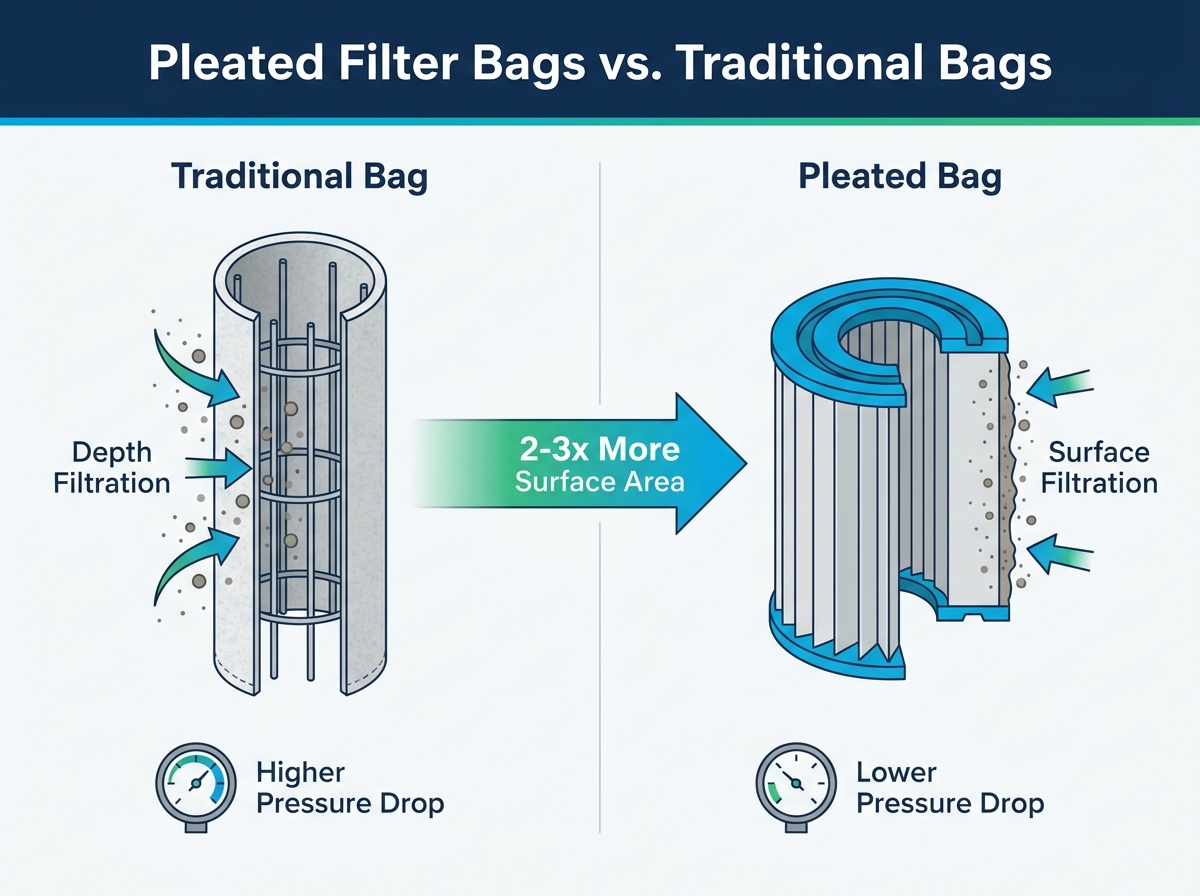
Surface Area & Capacity: Pleated filter bags provide 2–3 times the filtration surface area of traditional bags, effectively lowering the air-to-cloth ratio without modifying the physical baghouse footprint.
Filtration Mechanics: Traditional bags rely on depth filtration (allowing some particulate penetration), while pleated bags utilize surface filtration, drastically improving dust cake release and reducing pressure drop.
Cost vs. TCO: Pleated bags require a higher initial capital outlay but frequently offset this through reduced compressed air usage, lower fan energy loads, and extended lifespan.
Application Limits: Pleated filters are highly effective for fine, abrasive, or free-flowing dust, but are generally not recommended for highly agglomerative, sticky, or fibrous materials prone to "bridging" between pleats.
Production increases frequently push equipment beyond original design limits. Upgraded production lines generate higher volumes of particulate. This sudden increase easily overloads an aging dust collector. The system rapidly exceeds its intended capacity. We refer to this bottleneck as a high air-to-cloth ratio. When this ratio climbs, your system struggles to breathe.
You will quickly experience energy and maintenance overruns. Traditional media demands frequent pulse-jet cleaning under heavy loads. This constant pulsing wastes valuable compressed air. Furthermore, high differential pressure forces the main fan to work harder. The motor draws significantly more amperage just to maintain basic suction. These energy spikes eat directly into your monthly operating margins.
Regulatory compliance adds another layer of intense pressure. OSHA and the EPA continually tighten industrial emission standards. Facilities must aggressively monitor PM2.5 and PM10 particulate levels. Traditional needle-punched felt often struggles in these precise applications. It cannot consistently capture ultra-fine dust below certain micron thresholds. Unexpected fines and forced shutdowns become a very real threat.
Shortlisting Logic for Plant Upgrades:
Assess physical space constraints around the existing collector.
Determine if expanding the structural footprint is financially viable.
If space is limited, evaluate filter media upgrades immediately.
Target solutions offering increased volumetric airflow (CFM) within the current housing.
Expanding your physical baghouse footprint is rarely practical. Facility managers need creative, space-saving solutions. Upgrading your internal media often provides the smartest path forward. It allows you to maximize CFM without initiating a massive capital construction project.
Understanding your options requires a deep look at filtration mechanics. The industry relies on two fundamentally different methods to capture airborne particulate. We must compare them objectively to understand their operational impact.
Traditional Filter Bags (Depth Filtration)
Traditional media operates using a depth filtration principle. Manufacturers typically construct these from mechanically entangled needle-punched felt. Common base materials include polyester, aramid, and fiberglass. Dust must physically penetrate the outer fabric surface. It embeds deep within the fibers to form a primary dust cake. This established cake actually performs the fine filtering. However, this mechanism presents a severe long-term drawback. Particulates eventually embed too deeply into the material core. The fabric suffers irreversible blinding. You experience a permanent, unrecoverable pressure drop. The media completely loses its natural permeability.
Pleated Filter Bags (Surface Filtration)
Modern alternatives leverage a highly efficient surface filtration principle. Manufacturers build them using thermally bonded spunbond media. They frequently apply PTFE membranes or specialized chemical coatings to enhance slickness. Pleated Filter Bags capture dust strictly on the outermost boundary. They prevent deep particulate penetration entirely. This structural design offers distinct physical advantages. The inner core provides rigid structural stability. It is completely self-supporting. You entirely eliminate the need for separate internal metal cages. This drastically simplifies your entire installation and maintenance process.
Table 1: Depth Filtration vs. Surface Filtration Mechanics
Feature | Traditional Filter Media | Pleated Filter Media |
|---|---|---|
Filtration Principle | Depth filtration (internal fiber embedding) | Surface filtration (exterior barrier capture) |
Base Material Type | Needle-punched felt (Polyester, Aramid) | Spunbond synthetic media (often PTFE coated) |
Structural Support | Requires heavy, external metal cage | Self-supporting internal molded core |
Permeability Loss | High risk of irreversible blinding | Low risk; dust easily releases during pulsing |
You need concrete data to justify a system retrofit. We evaluate media performance across three critical operational categories. This matrix reveals how different materials handle severe industrial environments.
Traditional bags operate with a consistently higher baseline differential pressure. The system requires frequent pulsing as blinding inevitably occurs. Fans struggle continuously to maintain adequate suction at the pickup points. Conversely, pleated media changes this dynamic entirely. The densely packed surface area drastically reduces internal pressure drop. Fans run smoothly at significantly lower RPMs. This mechanical relief delivers measurable energy savings. You can pull the exact same or higher CFM without overloading the drive motor. This efficiency restores lost suction to your facility floor.
Traditional felt remains highly susceptible to mechanical wear. Cage friction aggressively damages the fabric during every pulse-jet cleaning cycle. The bags flex violently and slap against the metal wires. This flex fatigue destroys the fibers over time. The average lifespan is significantly shorter in high-load environments. Metal cages also rust, accelerating fabric degradation.
Pleated designs completely solve this mechanical friction issue. They feature rugged molded polyurethane or metal tops. The completely cage-free design prevents structural abrasion entirely. There is no internal metal wire to rub against the media. They easily last two to three times longer in compatible applications. Investing in a premium dust collector filter bag maximizes your overall production uptime.
Standard felt requires incredibly aggressive cleaning parameters. The system uses high-pressure compressed air pulses to dislodge embedded dust cakes. This aggressive shockwave slowly tears the media apart. Pleated media utilizes a slick, surface-loading principle. This allows for rapid and complete dust release. You can use much lower-pressure cleaning pulses. The dust simply slides off the spunbond material. This efficiency saves massive amounts of compressed air daily.
Best Practices for Maximizing Lifespan:
Conduct a comprehensive differential pressure audit before selecting new media.
Install variable frequency drives (VFDs) to control fan speeds automatically.
Monitor the compressed air header constantly for moisture or oil contamination.
Log your baseline pulse pressure and reduce it gradually after retrofitting.
We must evaluate the strict financial realities of a media upgrade. Upfront Capital Expenditure (CapEx) always raises immediate questions from procurement teams. Spunbond pleated elements cost noticeably more per unit than standard felt bags. We transparently acknowledge this initial friction point. However, the resulting Operating Expenses (OpEx) reductions quickly offset the premium.
First, you save significantly on maintenance labor. Faster change-outs become the new normal for your team. The simplified one-piece design ensures much shorter installation times. Your maintenance crew never removes, inspects, or repairs rusty metal cages again. This cuts turnaround time during shutdowns by more than half.
Second, you achieve highly quantifiable energy reductions. Variable Frequency Drive (VFD) fan power consumption drops dramatically. Lower system pressure drops mean the fan runs much slower to achieve target airflow. Compressed air generation costs also plummet. Compressors run less frequently because the media requires fewer cleaning pulses.
Finally, you virtually eliminate costly unplanned downtime. Fewer filter replacements mean much higher production uptime. You need a clear framework for ROI calculation. Continuous 24/7 operations often realize their payback rapidly. Facilities bottlenecked by restrictive baghouse capacity usually see full ROI within 6–12 months. Intermittent operations face a different mathematical reality. Traditional media may remain the most cost-effective choice for light-duty plants. If you want to review our rigorous manufacturing standards, visit our Company page.
You must conduct a thorough skeptic's check before purchasing. Upgraded media designs are not a universal cure-all. Pay close attention to your specific dust characteristic limitations. We strongly warn against using them for highly sticky or agglomerative dusts. Hygroscopic materials absorb moisture from the air and clump together. Fibrous materials create massive structural problems. They interlock and tightly bridge the narrow gaps between the pleats. This bridging prevents effective pulse cleaning and causes rapid, premature failure.
Pulse-jet system adjustments are absolutely critical. You must recalibrate the entire cleaning system post-retrofit. Upgrading requires dialing back both pulse pressure and firing frequency. Aggressive, high-pressure pulsing damages the rigid spunbond media. You must treat this new material differently than thick, flexible felt. We provide specialized services to help you optimize these sensitive settings.
Finally, carefully review your tubesheet compatibility. Retrofitting usually works seamlessly in standard units. Most elements drop directly into existing tubesheet holes without issue. However, you must validate all plate measurements carefully. Measure the exact hole diameter and plate thickness. Precision guarantees a proper, airtight seal. Bypass leaks destroy your emission compliance efforts instantly.
Common Mistakes During Retrofits:
Failing to lower the pulse-jet cleaning pressure, leading to blown media.
Ignoring moisture dew points in the airstream, causing severe pleat bridging.
Skipping a proper tubesheet hole measurement, resulting in bypass dust leaks.
Your final decision requires balancing operational expenses, initial capital cost, and dust compatibility. The framework is straightforward once you analyze your facility data. Choose traditional felt media for highly fibrous, moist, or sticky dusts. They also suit low-duty, budget-constrained applications perfectly.
Choose advanced spunbond media to solve immediate airflow bottlenecks. They rapidly reduce electrical energy consumption and eliminate frustrating cage maintenance. They excel in standard, fine, and abrasive dust environments. They transform an underperforming collector into a highly efficient asset.
Your next steps dictate your success. Encourage your operators to conduct a thorough differential pressure audit. Analyze your exact dust characteristics through independent lab testing. Do not guess your moisture or micron levels. Request a localized financial payback calculation from a filtration specialist before issuing a purchase order. If you need engineering support or have measurement questions, please contact us today.
A: Yes, they usually fit perfectly. Manufacturers design them as drop-in replacements. They work seamlessly for standard top-load or bottom-load designs. You utilize the existing tubesheet without heavy structural modifications. Always verify your precise hole diameter before ordering.
A: No, you do not need traditional cages. Pleated elements feature a rigid inner core. This makes them entirely self-supporting. You eliminate bulky metal cage inventory entirely. You also completely prevent cage-related mechanical wear on the fabric.
A: Fibrous materials behave unpredictably. They interlock and tightly bridge the narrow gaps between the pleats. Sticky dust acts similarly. This prevents the pulse-jet from effectively cleaning the filter. The material builds up quickly. This leads to rapid blinding and complete failure.
A: Pleated designs pack more filter media into the exact same physical footprint. Your effective filtration area increases significantly. This lowers your air-to-cloth ratio instantly. It reduces mechanical strain on the entire dust collection system while improving airflow.