Views: 0 Author: Site Editor Publish Time: 2026-10-13 Origin: Site
In industrial filtration, a filter bag is only as reliable as its weakest seam. Poor stitching inevitably leads to dust leakage, strict emissions compliance violations, and costly production downtime. These failures severely disrupt daily operations and damage your company reputation. Selecting the correct equipment requires perfectly matching stitch mechanics, feeding systems, and automation levels to your specific filter media and production volume. Every fabric type behaves differently under mechanical tension. This guide provides a clear framework to thoroughly evaluate technical specifications. We will show you how to mitigate operational risks and shortlist equipment perfectly aligning to your facility's unique requirements. By the end, you will know exactly how to evaluate different models, run effective material trials, and execute a highly successful procurement strategy.
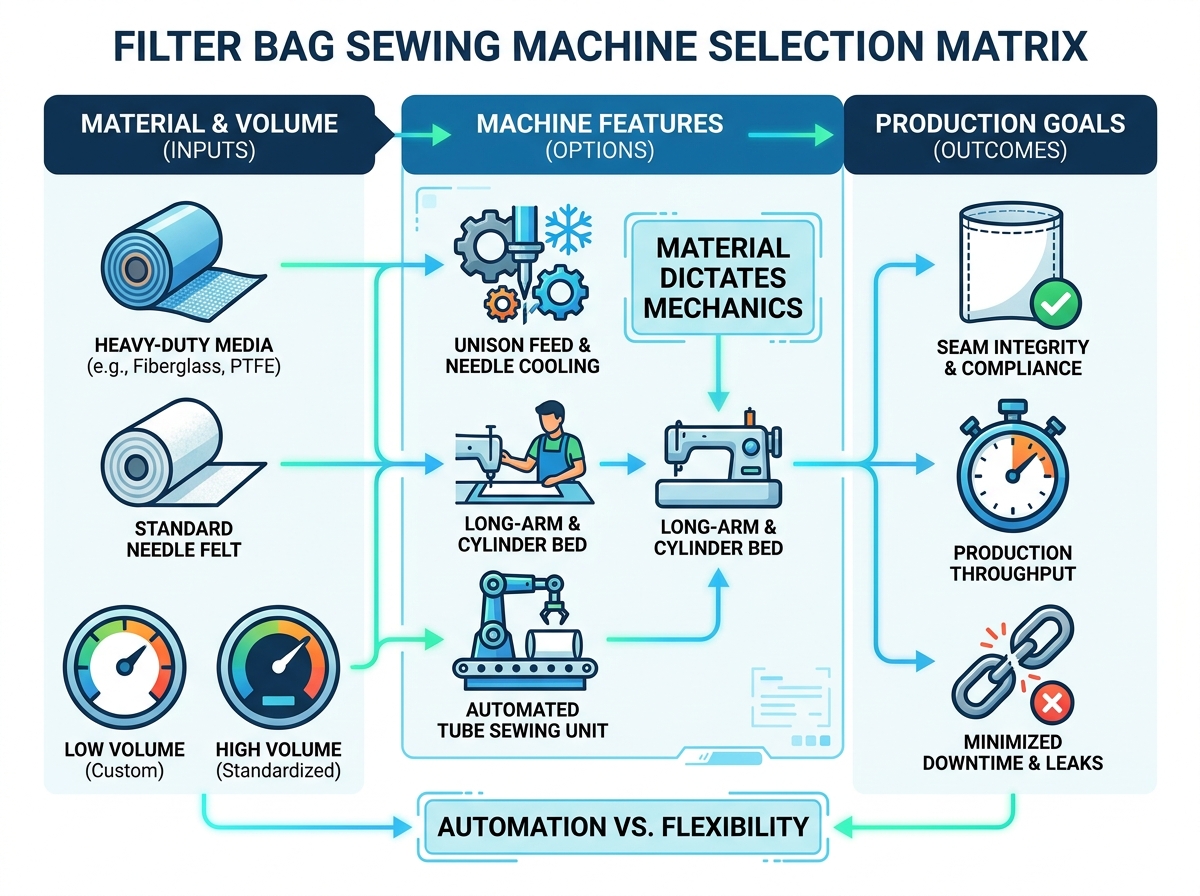
Material dictates mechanics: Heavy-duty media (like fiberglass or PTFE) require specialized feeding mechanisms and needle cooling systems to prevent material damage.
Stitch selection impacts compliance: Double-needle chain stitches and overlock stitches offer different tensile strengths and leak-prevention profiles.
Automation vs. Flexibility: Fully automatic lines maximize high-volume tube production, while semi-automatic or long-arm machines provide necessary flexibility for complex custom bags.
Real-world testing is non-negotiable: Never finalize a purchase without conducting Factory Acceptance Testing (FAT) using your actual production materials and thread.
Modern industrial facilities face strict environmental regulations. Dust collection systems must capture microscopic particles effectively. If a seam fails, particulate matter escapes directly into the atmosphere. You must evaluate how specific stitching capabilities prevent these microscopic breaches. A reliable Filter Bag Sewing Machine ensures consistent tension. Consistent tension minimizes needle hole expansion. Large needle holes create pathways for dust leakage. Selecting proper equipment guarantees you meet demanding EPA compliance metrics consistently. Seam integrity directly dictates your filtration efficiency.
You need a clear understanding of your daily production targets. Calculate your required bags per hour accurately. This calculation determines the correct level of machinery automation. Manual machines work well for small, customized batches. Semi-automatic solutions bridge the gap for medium-sized operations. Fully automated lines justify their footprint when handling thousands of standardized bags daily. Matching equipment speed to your output requirements prevents painful operational bottlenecks. It ensures your assembly line flows smoothly without overworking your staff.
Different parts of a filter bag require entirely different stitch profiles. Manufacturers classify equipment based on these structural stitching abilities.
This stitch represents the global industry standard for longitudinal bag seams. It creates a highly elastic structural bond. Filter bags constantly expand and contract during pulse-jet cleaning cycles. A rigid seam would snap under this repetitive stress. Type 401 chain stitches stretch naturally. They provide immense structural integrity across long continuous runs.
Woven fiberglass and certain synthetic media fray easily. Fraying compromises the filter's operational lifespan. Overlock stitches wrap around the raw fabric edge. They lock loose fibers into place securely. Operators frequently combine an overlock stitch alongside a standard chain stitch. This combination delivers superior edge binding and prevents disastrous material unraveling.
Lockstitches offer zero stretch. They interlock threads tightly inside the material layers. You need this rigidity when attaching heavy components. Snap bands, metal rings, and reinforced bottom caps require absolute security. A specialized Filter Bag Sewing Machine utilizing a Type 301 stitch ensures heavy attachments never loosen during turbulent operations.
Stitch Type | Primary Application | Key Benefit | Stretch Tolerance |
|---|---|---|---|
Type 401 (Chain Stitch) | Longitudinal side seams | Handles pulse-jet expansion | High |
Type 504/505 (Overlock) | Raw edge binding | Prevents material fraying | Moderate |
Type 301 (Lockstitch) | Snap bands and bottom caps | Maximum component security | Low |
Custom filter bags often feature complex geometries. Heavy, bulky filter tubes require physical maneuvering. Cylinder bed designs allow operators to slide tubular fabrics easily over the sewing arm. Long-arm machines provide massive workspace clearance. These units remain ideal for custom small-batch runs. They empower skilled workers to handle thick materials manually.
Standardized cylindrical bags demand high-speed production. Automated units handle continuous feeding, precise folding, and rapid cutting seamlessly. They eliminate heavy manual handling. These sophisticated systems pull fabric straight from large material rolls. They sew perfect longitudinal seams autonomously. They represent the ultimate solution for high-volume manufacturing environments.
Feeding heavy fabric evenly poses a significant engineering challenge. Drop feed systems only push the bottom fabric layer. This often causes top layers to drag behind. Needle feed systems pull the top layer simultaneously. However, they still struggle against extremely thick media. Unison feed systems, also known as walking foot mechanisms, solve this problem entirely. They move the top, bottom, and needle simultaneously. We highly recommend unison feed configurations. When you evaluate a Filter Bag Sewing Machine, ensure it includes upper and lower pullers. This prevents ply-shifting and frustrating puckering on thick needle felt.
Industrial sewing generates extreme friction. High-speed needles easily reach temperatures exceeding 300 degrees Celsius. Synthetic media and PTFE threads melt instantly under these conditions. Melted thread snaps immediately. It halts production and ruins expensive fabric. You must evaluate internal compressed air cooling systems. These systems blow cold air directly onto the needle shaft. Thermal management remains an essential criterion for processing synthetic filtration media safely.
Operators face severe fatigue when manually lifting heavy presser feet. Pneumatic lifters use compressed air to raise the foot effortlessly. This minor upgrade drastically reduces operator exhaustion. Furthermore, automatic thread tension controls adapt to changing material thickness dynamically. Crossing over a folded side seam doubles the material thickness instantly. Smart tension controllers maintain consistent stitch tightness across these difficult transitions.
Certain industries demand absolute zero-leakage performance. Even tiny needle holes compromise these extreme standards. You must evaluate integration capabilities for secondary sealing steps. Many modern systems feed hot-melt tape directly into the seam path. Others inject silicone seam-sealing cords alongside the thread. These enhancements block microscopic dust particles completely. They transform a standard stitched seam into an impenetrable barrier.
Heavy-duty industrial sewing requires incredibly precise mechanical calibration. You cannot simply plug these units in and start producing. Technicians must adjust tension based on specific thread denier. They must calibrate looper timing precisely to match your media thickness. Skipping this setup phase leads directly to skipped stitches and ruined bags. Recognize this initial calibration burden before you finalize any deployment schedule.
Different equipment types require drastically different skill sets. Consider these two distinct profiles carefully:
Manual Cylinder Bed Operation: Operators need immense physical dexterity. They must guide heavy, six-meter tubes perfectly straight by hand. The learning curve takes months to master.
Automated Line Operation: The physical burden disappears entirely. However, operators must understand software interfaces. They must troubleshoot sensor faults and clear complex mechanical jams.
You must weigh your available workforce capabilities against these specific learning curves.
Industrial machinery inevitably suffers wear and tear. Abrasive fiberglass media destroys metal feed dogs quickly. Heavy vibrations knock looper timing out of perfect alignment. You must address these common failure points proactively. Evaluate your supplier thoroughly. Assess their spare parts availability before buying anything. A high-quality Filter Bag Sewing Machine manufacturer provides rapid response times and locally stocked replacement components.
You should never purchase industrial sewing equipment based on a brochure. Real-world testing remains absolutely critical. You must conduct Factory Acceptance Testing (FAT). Send your exact production media to the vendor. Include your specific needle felt, woven fiberglass, and specialized PTFE threads. Demand comprehensive test runs. Watching your exact materials run through their equipment reveals hidden mechanical flaws instantly.
Vendors will return the sewn samples to you. Inspect these test runs meticulously. Look for the following critical indicators:
Stitch Uniformity: Check for equal spacing between every single thread loop.
Needle Hole Elongation: Ensure holes remain tight circles. Oval holes indicate the machine is dragging your fabric.
Tensile Breaking Strength: Pull the seam apart aggressively. The fabric should tear before the structural thread snaps.
Your relationship with the vendor begins after the sale. Post-sale integration support is vital for early success. Assess their willingness to provide on-site training for your staff. Review the warranty terms covering high-wear components like loopers and needle bars. A supportive vendor guarantees a much smoother transition into active production.
Choosing the correct equipment defines your manufacturing success. Your final selection must carefully balance specific material constraints, required daily production volume, and strict seam compliance standards. There is no universal solution for every facility. You must prioritize unison feed mechanisms for heavy media. You must demand active cooling for delicate synthetic threads. Start by auditing your current production bottlenecks. Identify whether speed or defect rates cause your biggest headaches. Once you define these pain points, draft a highly technical RFQ. Reach out to specialists to test a Filter Bag Sewing Machine using your exact production materials. Taking these exact steps ensures a profitable and reliable machinery upgrade.
A: A double-needle chain stitch (Type 401) is highly recommended for PTFE filter bags. This stitch provides exceptional durability and high flexibility. It accommodates the natural expansion of bags during pulse-jet cleaning. You must utilize specialized PTFE thread and enforce strict needle cooling protocols to prevent heat damage during high-speed production runs.
A: Generally, no. Longitudinal side seams require high-speed continuous feeding, making long-arm tube sewers or automated lines ideal. Bottom caps require complex maneuvering and rigid lockstitches, making cylinder bed machines necessary. In high-volume settings, we strongly recommend deploying specialized machines for each distinct production step to maintain efficiency.
A: You can eliminate dust leaks by utilizing correct needle profiles designed for your specific filter media. Optimizing thread tension prevents the needle hole from stretching unnaturally. Furthermore, you should apply sealing cords or specialized PTFE seam tape directly into the stitch line during the sewing process for maximum protection.