Views: 0 Author: Site Editor Publish Time: 2026-10-01 Origin: Site
Plant managers face immense operational pressure today. You must increase production capacity constantly. At the same time, strict emission standards demand flawless filtration. Upgrading an entire baghouse infrastructure requires massive capital and significant downtime. Fortunately, a highly effective retrofit solution exists to bridge this gap.
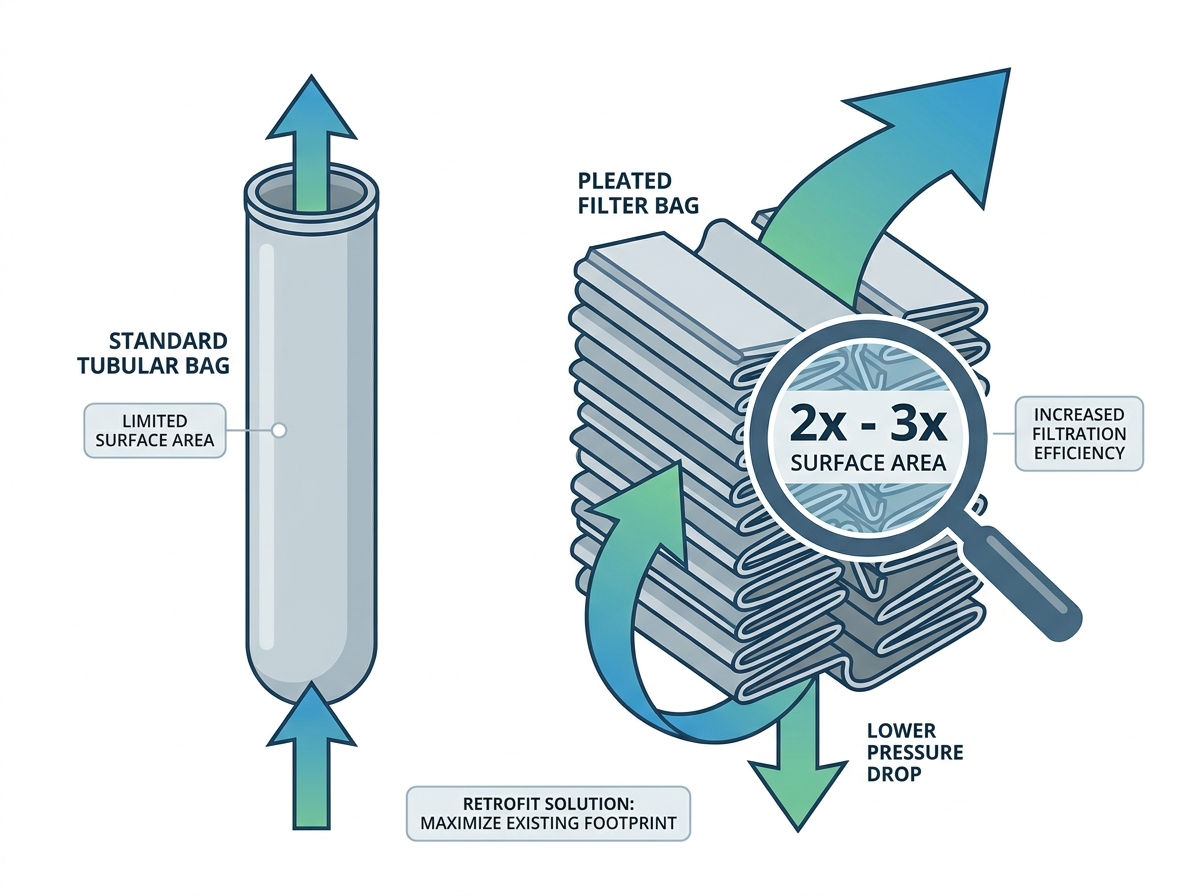
Pleated Filter Bags maximize your existing dust collector efficiency. They exponentially increase filtration surface area without altering your equipment footprint. You simply replace traditional tubular filters to unlock immediate performance gains.
This article delivers a transparent, engineering-based evaluation of pleated filters. We will explore their design principles, operational benefits, and long-term financial returns. You will discover exactly where they fit into your industrial filtration strategies. Read on to master the facts before planning your next baghouse upgrade.
Surface Area Maximization: Pleated designs offer 2x to 3x more filtration area than conventional tubular bags within the same equipment footprint.
Total Cost of Ownership (TCO): While upfront costs are higher, operational savings are realized through reduced compressed air consumption, lower fan energy costs, and extended maintenance intervals.
Retrofit Feasibility: Most pulse-jet dust collectors can be upgraded to pleated bags without structural modifications to the tubesheet.
Application Limits: Highly effective for fine, abrasive, or moisture-laden dust, but not recommended for highly fibrous materials due to the risk of pleat bridging.
Filtration technology has evolved significantly over the past few decades. Industrial facilities traditionally relied on heavy felt or woven fabrics. These older materials depend heavily on depth filtration. Dust particles embed deeply into the fabric layers to form a filtering cake. Today, modern pleated designs utilize rigid spunbond media. This engineered fabric shifts the process toward surface filtration. It stops fine dust on the outer layer. This prevents particles from penetrating and blinding the material.
The "extended surface area" principle defines this technology. Manufacturers fold the spunbond media into tight pleats. This folding process packs exponentially more usable fabric into a smaller physical space. We call this air-to-cloth ratio optimization. You drastically increase the filtration area without increasing the actual bag length. The physics remain straightforward but highly effective. More surface area allows air to pass through at lower velocities. This protects the filter from rapid wear and tear.
Pleated designs also introduce structural innovations. Conventional filters require separate metal cages for internal support. These cages often bend, rust, or damage the fabric during installation. Pleated versions eliminate this problem entirely. They feature an integrated inner support core. The rigid core bonds directly to the pleated media during manufacturing. This creates a solid, one-piece component. You no longer need to manage two separate inventory items. The unified design streamlines both performance and routine maintenance.
Evaluating industrial filtration requires a clear look at capital outlay versus long-term ROI. Pleated filters carry a premium upfront price. Plant managers must calculate the true financial return over time. You must factor in the initial purchase price alongside massive energy savings. Standard bags consume vast amounts of fan energy and compressed air. Pleated upgrades reverse this trend. They also slash replacement labor costs dramatically. The initial premium pays for itself rapidly through these operational efficiencies.
Pressure drop dynamics highlight another massive difference. Standard filters experience high and wildly fluctuating differential pressure. Dust embeds deeply into felt materials, choking off airflow. Pulse-jet cleaning struggles to dislodge these deep particles. Pleated filters maintain lower, highly stable differential pressure. Surface filtration ensures dust cakes release easily during cleaning cycles. Your exhaust fans no longer fight against clogged media. This stability protects your production environment from sudden airflow drops.
Lifespan and durability favor pleated designs heavily. Traditional long bags often swing inside the collector housing. They strike the bottom hoppers or neighboring metal parts. This causes bottom-abrasion, which remains a primary failure point. Pleated filters fix this by utilizing a much shorter physical length. They keep the media far above the abrasive inlet zones. This shorter profile prevents mechanical wear and extends operational life.
Maintenance labor presents a stark contrast. Replacing standard filters demands complex, physically exhausting work. Technicians must extract long, dirty cages and separate them from old bags. They then slide new bags over reused cages before installation. Pleated alternatives offer a one-piece, drop-in installation. Technicians simply drop the unified cartridge into the tubesheet. This transforms a multi-day maintenance shutdown into a rapid shift project.
Table 1: Performance and Operational Comparison
Feature | Standard Felt Bags | Pleated Filter Alternatives |
|---|---|---|
Filtration Area | Baseline | 2x to 3x Greater |
Installation Method | Two-piece (Bag + Cage) | One-piece (Integrated Core) |
Differential Pressure | High and Fluctuating | Low and Stable |
Abrasion Risk | High (Bottom Strike) | Low (Shorter Profile) |
Initial Capital Cost | Low | Premium |
Every facility needs a reliable dust collector filter bag strategy. Comparing these features objectively helps you make data-driven purchasing decisions.
Energy efficiency stands out as a primary financial driver for this upgrade. Lower differential pressure links directly to reduced fan horsepower requirements. When air flows freely through the dust collector, your main draft fans consume less electricity. Furthermore, pleated filters release dust much easier. This means your pulse-jet cleaning system triggers less often. You will decrease your compressed air usage significantly. Compressed air remains one of the most expensive utilities in any manufacturing plant.
Increased throughput solves major production bottlenecks. Many facilities outgrow their original dust collection infrastructure. Upgrading allows a facility to increase airflow (CFM) instantly. You can handle higher production volumes without buying a larger dust collector housing. The massive boost in surface area absorbs the extra dust loading effortlessly. This allows plant managers to expand manufacturing lines without facing costly capital equipment constraints.
Emissions compliance becomes increasingly strict every year. Regulatory bodies like the EPA and OSHA demand lower emission thresholds. Standard felts struggle to capture extremely fine particulate. Advanced pleated media, such as spunbond polyester, achieves superior collection efficiency. They excel at sub-micron particulate retention. Upgrading ensures your stack emissions remain visibly clear. You protect employee health and avoid costly regulatory fines.
Reduced downtime translates directly to higher profitability. Standard filters require frequent change-outs due to abrasion or blinding. Every hour spent replacing filters equals lost production time. Pleated versions extend filter life drastically. They also install in a fraction of the time. You frame this extended filter life as a measurable recovery of lost production hours. Maintenance teams spend less time inside hazardous baghouses and more time optimizing plant machinery.
Selecting the correct media type determines the success of your filtration strategy. You must match the fabric to the specific characteristics of your industrial dust. A mismatched media will fail rapidly, regardless of the pleated design.
Standard Spunbond Polyester: This serves as the workhorse for general dry dust. It handles ambient temperatures well. It offers excellent rigidity for the pleating process and handles moderate dust loading efficiently.
Aluminized and Anti-Static: Facilities face massive risks in explosive or combustible dust environments. Static electricity can ignite fine dust clouds. Anti-static spunbond media safely dissipates these electrical charges. You must use these to comply with NFPA safety standards.
ePTFE Membrane: This specialized coating bonds directly to the base media. It proves absolutely necessary for sticky or agglomerative dust. It also excels in high-moisture environments. The slick surface ensures excellent dust cake release, preventing the pleats from packing solid.
Different sectors reap specific benefits from these advanced filters. We can evaluate their performance across several demanding environments:
Cement and Minerals: This sector generates highly abrasive, heavy dust. Standard long bags fail quickly due to bottom-abrasion. The shorter, durable pleated elements withstand this harsh environment perfectly.
Metalworking and Welding: Plasma cutting and welding produce ultra-fine, sub-micron fumes. Spunbond media captures these microscopic particles effectively, ensuring clean breathable air in the facility.
Food Processing: Food dust often absorbs moisture and becomes sticky. Using an ePTFE membrane prevents organic powders from blinding the media. It also aids in strict sanitation compliance.
Chemical Manufacturing: Corrosive dust demands robust media. Advanced spunbond configurations resist chemical attacks. They maintain structural integrity even under continuous heavy loading.
Pleated filters offer incredible benefits, but they are not a universal solution. Transparent engineering requires acknowledging their application limits. Misapplying this technology guarantees rapid failure and wasted capital.
The bridging risk presents the most common failure mode. You must absolutely advise against using pleated designs for highly fibrous dust. Heavy, stringy materials like paper scraps, wood shavings, or heavy textiles cause immediate problems. These long fibers pack tightly into the narrow V-shaped pleats. Once packed, standard pulse-cleaning cannot dislodge them. The pleats bridge over, blocking all airflow. Your differential pressure will spike irreversibly.
Moisture thresholds require careful consideration. Misapplying standard spunbond media in high-humidity applications leads to rapid blinding. If hot air cools inside the collector, condensation occurs. The dust turns into a muddy paste. Without an ePTFE membrane, this paste embeds deep into the spunbond fibers. The filters will cement shut. You must audit your moisture levels and dew points before choosing a base material.
Hardware compatibility rarely causes issues, but you must verify it. Most top-load and bottom-load pulse-jet collectors accept these cartridges seamlessly. However, older shaker systems or reverse-air systems operate differently. They lack the high-pressure burst needed to clean rigid pleated media. These older systems require specific structural audits before retrofitting. Attempting to install them in an incompatible cleaning system will ruin the media quickly.
Pleated filter bags represent a high-ROI upgrade for specific industrial challenges. They are the ideal solution for facilities facing bottlenecked airflow. They eliminate frequent abrasion failures and slash high energy costs. By moving from depth filtration to surface filtration, you stabilize your entire dust collection process.
Implementing this upgrade requires a logical, progressive evaluation. Follow these steps to ensure success:
Identify the current failure modes of your standard bags. Look for bottom abrasion, high differential pressure, or frequent blinding.
Audit your current dust characteristics. Evaluate particle size, abrasiveness, moisture content, and fibrous tendencies.
Calculate your potential energy and labor savings over a multi-year timeline to justify the upfront premium.
You do not need to make these decisions blindly. We recommend validating your assumptions with professional guidance. Request a comprehensive site audit or sample media testing today. Our company employs seasoned filtration specialists ready to optimize your baghouse. Explore our full range of services to see how we can boost your production throughput. When you are ready to eliminate dust collector bottlenecks, contact us for a customized engineering consultation.
A: No, structural modifications are rarely necessary. Manufacturers design them as direct drop-in replacements for most systems. They utilize custom molded top-configurations, such as snap-bands or top-flanges. These precisely match your existing tubesheet hole dimensions, ensuring a perfect seal without welding or cutting.
A: They typically last two to three times longer than standard felt alternatives. This extended lifespan stems from their shorter length, which prevents bottom-abrasion, and their rigid spunbond media. However, actual lifespan always depends heavily on your specific operating conditions, dust loading, and pulse-cleaning cycles.
A: Industry experts generally discourage washing them. While the rigid structure seems durable, washing degrades the media's natural permeability. Water also strips away vital surface treatments like ePTFE membranes or anti-static coatings. Replacing them ensures you maintain peak filtration efficiency and regulatory compliance.
A: No, you do not need separate cages. The rigid inner core is permanently built into the pleated cartridge during the manufacturing process. This eliminates the need to purchase, inventory, or install heavy separate metal cages, vastly simplifying your maintenance workflow.