Views: 0 Author: Site Editor Publish Time: 2026-06-02 Origin: Site
Production managers in filtration manufacturing face a constant dilemma. You must balance high output speeds against strict seam integrity requirements. Industrial dust collection systems demand absolute perfection to prevent catastrophic filtration failures. Minor needle punctures or weak seams easily compromise the entire baghouse environment.
Relying on generic heavy-duty sewing equipment no longer suffices for modern compliance standards. Unspecialized machines often cause skipped stitches, thread breakage, or inconsistent tension. These flaws directly trigger filter bypasses. Ultimately, this leads to expensive product recalls and severe operational downtime for your clients.
Transitioning to specialized machinery resolves these exact bottlenecks. We will explore how specific mechanical features directly impact your daily yield rates and environmental compliance. You will get a clear, unbiased framework to evaluate machine specifications. This guides you in matching equipment capabilities directly to your facility’s unique material needs and production goals.
Stitch Integrity Reduces Liability: Precision tensioning and specialized feed mechanisms directly correlate to lower environmental compliance risks in the final filter bag product.
Configuration Dictates Capacity: Choosing the correct arm style and needle configuration (e.g., cantilever vs. short-arm) is critical for handling specific tubular dimensions.
Automation Requires Operator Buy-in: Automated cutting and feeding features improve throughput but require distinct maintenance protocols and operator training to realize ROI.
Total Cost of Ownership (TCO): Upfront evaluation of motor penetration power and parts availability significantly outweighs initial capital expenditure in high-volume settings.
Selecting the right machinery dictates your overall factory efficiency. You need concrete metrics to evaluate equipment performance. First, assess seam burst strength. Industrial air filtration environments subject bags to intense reverse-pulse cleaning. Seams must withstand sudden pressure spikes without rupturing. Next, measure production units per hour. Speed matters, but it cannot compromise precision. Finally, track machine uptime. Frequent maintenance stops destroy your daily yield targets.
Skipped stitches create immediate liabilities. An inadequate thread tension setting allows fine particulate matter to escape. We call this filter bypass. When bypass occurs, clients fail their environmental emissions tests. They face fines and operational shutdowns. Defective bags inevitably trigger mass product recalls. Your facility absorbs the replacement costs and suffers reputational damage.
Deciding between upgrading existing lines and scaling operations requires careful analysis. Augmenting current lines might solve minor bottlenecks. However, heavy materials quickly wear out standard motors. Investing in a purpose-built Filter Bag Sewing Machine transforms your production floor. Dedicated machines handle thicker media effortlessly. They sustain continuous operation schedules. Evaluate your current rejection rates. If operators spend hours repairing blown seams, you need specialized hardware.
Industrial filter bags use notoriously difficult materials. Fiberglass, PTFE, and heavy needle-punched felt resist standard needle penetration. Your equipment requires serious mechanical power to puncture multiple layers smoothly.
Drive motors dictate baseline capabilities. Modern direct-drive servo motors outclass traditional clutch motors. Servo technology delivers maximum torque instantly. They push heavy needles through dense fiberglass without stalling. Clutch motors often slip under extreme loads. Servo motors also run cooler during continuous shifts. They consume less electricity and provide superior speed control for intricate work.
Feature | Direct-Drive Servo Motor | Traditional Clutch Motor |
|---|---|---|
Penetration Torque | High; instant power delivery | Moderate; prone to slipping |
Speed Control | Precise digital adjustments | Manual pedal modulation |
Heat Generation | Low; efficient continuous run | High friction during operation |
Material Suitability | Heavy PTFE, dense felt, multi-layer | Light to medium canvas |
Feeding mechanisms directly impact seam consistency. Standard drop feeds fail when sewing thick filtration media. The top layer drags while the bottom layer advances. This causes material shifting and puckered seams. You must utilize compound feed architectures. A compound feed combines drop feed, needle feed, and a walking foot. All three components move the fabric simultaneously. The needle stays embedded in the material while advancing. This guarantees perfect layer alignment across ten-foot-long seams.
Thread tensioning systems require specific upgrades. Extra-thick media generates intense friction against the thread. This friction melts synthetic threads or snaps them entirely. Heavy-duty thread tensioners maintain precise pull forces. They adapt dynamically to varying fabric thicknesses. Furthermore, automatic lubrication mechanisms cool the needle. They deliver micro-drops of oil directly to the hook and needle shaft. This prevents thread breakage and protects internal gears during high-speed, multi-shift operations.
Baghouse designs dictate filter bag geometry. Production facilities manufacture various shapes, from standard tubes to complex envelope styles. Your machine's physical architecture determines what bags you can effectively construct.
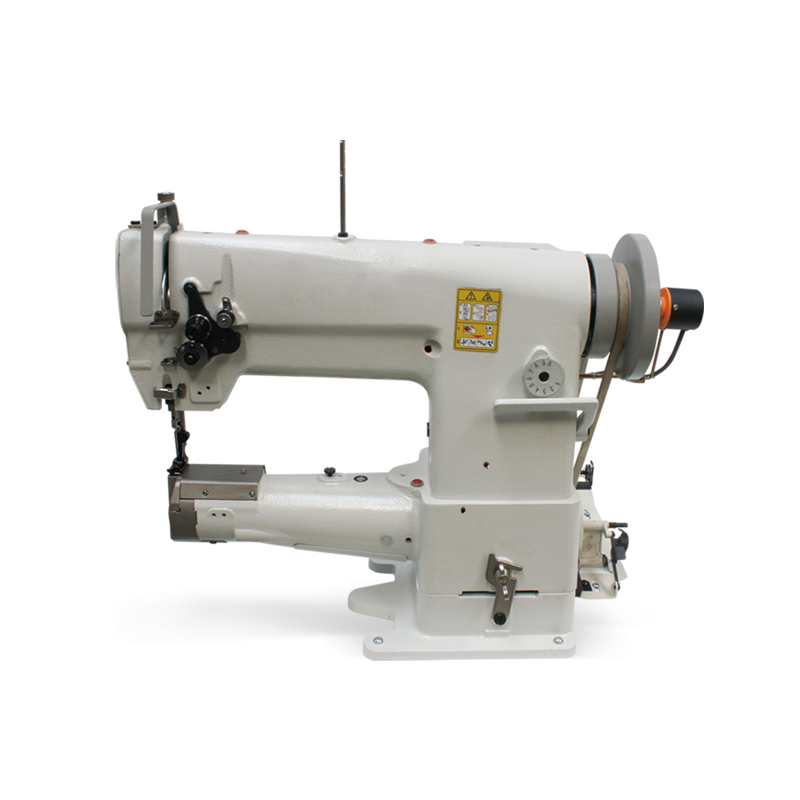
Tubular construction presents unique ergonomic challenges. Closing a long, narrow-diameter filter tube on a flatbed machine proves nearly impossible. The material bunches up around the needle plate. A specialized arm geometry solves this spatial constraint. A 3-Line Cantilever Sewing Machine for Tubular Dust Bags suspends the sewing bed in the air. Operators slide the entire tube over the arm. This design provides uninterrupted feeding. The material flows naturally without restriction. It drastically reduces operator handling time and eliminates accidental fabric folds within the seam.
Filter bags often require heavy attachments. Snap bands secure the bag into the tube sheet. Heavy reinforced bases prevent wear against metal cages. Navigating these complex joints requires extreme maneuverability. A Two-needle Short-arm Sewing Machine for Industrial Filter Bags excels here. The shortened cylinder bed allows operators to rotate rigid snap rings easily under the needle. It provides the perfect turning radius for circular base insertions. You gain precision control over high-stress reinforcement joints.
Choosing the correct stitch type dictates field performance. Consider the following configurations:
Double-Needle Chain Stitch: Highly elastic and fast to produce. The chain structure stretches slightly under pulse-jet cleaning. This flexibility prevents thread snapping during violent air bursts.
Lockstitch Configuration: Incredibly secure but less flexible. If one thread breaks, the entire seam does not unravel. It works exceptionally well for attaching heavy hardware like rings and cuffs.
Three-Line Systems: Combines sealing power and mechanical strength. This setup often includes two structural stitches and one overedge stitch. It traps raw fabric edges, preventing loose fibers from entering the clean air stream.
Scaling production requires more than simply running motors faster. Operator fatigue causes errors late in a shift. Automated mechanical assists eliminate repetitive physical strain. This keeps cycle times consistent from morning until night.
Pneumatic features transform the sewing experience. Automatic thread trimmers slice heavy multi-ply threads instantly. Operators never reach for hand scissors. Pneumatic foot lifters raise the heavy walking foot via a simple heel tap on the pedal. This saves thousands of manual lever pulls daily. Synchronized pullers sit behind the needle block. They gently grip the finished seam and pull it backward. This assists the feed dog and prevents operators from dragging heavy, fifty-pound filter tubes by hand.
Digital interfaces introduce programmable flexibility. Filtration factories rarely run identical bags all year. You might switch from sewing cement plant bags in the morning to food-grade filtration sleeves in the afternoon. Digital control panels store specific parameters. You can save stitch lengths, speed limits, and tension memory profiles. Operators press one button to switch product lines. This eliminates manual mechanical adjustments and reduces changeover times from hours to minutes.
Sensor integration prevents costly material waste. Heavy thread spools sometimes snag or run out unnoticed. Thread-break detectors stop the motor immediately if tension drops. This prevents operators from running three feet of unsewn material through the machine. Fabric-edge sensors align the raw media perfectly before the needle strikes. If the material drifts out of alignment, the machine halts. You avoid defective runs entirely before they reach the quality control department.
Deploying heavy-duty industrial equipment brings distinct daily realities. High-speed sewing creates immense vibrations. Abrasive materials like fiberglass generate microscopic dust. You must manage these factors proactively to maintain production quotas.
Maintenance schedules dictate your actual uptime. Sewing thick media forces mechanisms out of alignment over time. Hook timing requires routine checks. If the rotary hook fails to catch the needle loop perfectly, the machine skips stitches. Needles dull rapidly when punching through dense PTFE. You must establish strict needle replacement schedules. Furthermore, lint buildup presents a massive operational risk. Abrasive fiberglass fibers accumulate inside the hook assembly. They act like sandpaper against moving metal parts. Mechanics must use compressed air and specialized vacuums daily to clear this debris.
Moving to highly automated systems highlights the operator skill gap. Veteran workers often rely on physical intuition. They manually guide fabric through older clutch machines. Upgrading to synchronized, sensor-driven systems changes their entire workflow. New machines pull the fabric automatically. Operators must learn to guide rather than force the material. You must budget dedicated onboarding time. Rushing the training phase causes user frustration and leads to intentional sensor overrides on the floor.
Vendor support capabilities determine your long-term success. Specialized industrial machines use proprietary components. Standard tailoring shops cannot supply your replacement parts. You need specialized heavy-duty loopers, specific gauge sets, and titanium-coated needles. Verify the local availability of these consumables before signing a purchase order. Relying solely on overseas shipping for a broken feed dog halts your production line for weeks. Establish a robust spare parts inventory on day one.
Selecting modern filtration sewing equipment demands a systematic approach. First, define your heaviest material thickness to determine required motor torque. Next, analyze your bag diameters to choose between flatbed, short-arm, or cantilever configurations. Finally, map out your daily output targets to justify pneumatic assists and sensor automation.
Generic machinery cannot support the strict compliance needs of the industrial dust collection sector. Precision mechanics, specialized feed systems, and structural arm geometries are non-negotiable for producing reliable seams.
Your next step requires physical validation. Do not purchase equipment based solely on specification sheets. Request a live sample test. Send your actual filter media, your exact heavy-duty thread, and your specific bag dimensions to the manufacturer. Ask for a video-documented test run. This proves the machine handles your exact configuration without skipped stitches or material bunching.
A: The industry standard typically involves a double-needle chain stitch or a heavy-duty lockstitch. Chain stitches offer necessary elasticity for pulse-jet cleaning systems. Lockstitches provide absolute security for attaching heavy rings. The exact configuration varies based on post-sewing treatments, such as applying taped or glued seams to seal needle punctures completely.
A: A cantilever arm is suspended, offering massive clearance underneath and around the sewing zone. A standard cylinder bed connects to a machine base, limiting fabric drape. The cantilever design provides uninterrupted feeding for extremely long tubular structures, preventing the heavy filter media from bunching up around the needle plate.
A: Technically yes, but practically it requires significant physical changeovers. Heavy PTFE demands aggressive feed dogs and larger needle gauges. Lightweight fiberglass requires finer teeth to prevent fabric tearing. You cannot sew both efficiently using the same setup. Facilities typically dedicate specific machines to specific material weights to maximize daily uptime.