Views: 0 Author: Site Editor Publish Time: 2026-03-18 Origin: Site
Industrial water treatment requires more than basic particulate interception. It demands safeguarding high-value downstream assets from catastrophic contamination. Pumps, heat exchangers, and delicate membranes rely heavily on pristine fluid streams. Selecting the wrong liquid filter bag creates massive operational risks. You might face bypass leakage, sudden pressure drops, and excessive maintenance downtime. This guide evaluates industrial liquid filter bags based on material chemistry, structural integrity, and Total Cost of Ownership (TCO). We help engineers and plant managers make evidence-based procurement decisions. Modern facilities require comprehensive environmental control. You manage dry chemical handling areas utilizing dust collector filter bags for airborne particles. Similarly, your wet processing streams rely on highly engineered liquid filter bags. Both systems demand precise material selection to keep your plant running smoothly.
Material dictates survival: Polypropylene (PP) is ideal for general chemical resistance, while extreme environments demand PTFE or Polyester (PE).
Construction prevents bypass: Welded seams and precision plastic flanges eliminate the needle-hole bypass risks common in cheap, sewn bags.
Precision vs. Flow: Misunderstanding the difference between "Nominal" and "Absolute" micron ratings is the leading cause of premature bag blinding and system pressure loss.
TCO matters more than unit price: Premium bags reduce labor costs, minimize pump energy consumption, and prevent costly unplanned downtime.
Many operators treat filter bags as simple consumables. They simply expect them to catch dirt. However, you should view them as critical system barriers. A properly chosen bag stabilizes system pressure. It prevents expensive downstream polishing filters from fouling. Reverse osmosis (RO) membranes and costly microfiltration cartridges depend entirely on this primary defense. If your pre-filtration fails, your polishing filters blind instantly.
Poor selection introduces severe business risks. Bag collapse often occurs when unsupported media faces sudden viscosity spikes. Extreme pressure differentials crush weak fibers easily. Particle bypass happens when poor sealing allows raw fluid around the edges. These failures stop production entirely. They force unplanned maintenance schedules and ruin downstream equipment. Industries like automotive electrocoating or food processing suffer massive losses from a single bypass event.
You must evaluate your baseline needs before purchasing anything. We recommend assessing three primary metrics to start your selection process:
Target flow rates: Determine your maximum gallons per minute (GPM) or liters per minute (LPM).
Acceptable pressure drops (ΔP): Know your system limits and pump curves.
Contaminant nature: Identify whether you have hard particulates, abrasive sand, or deformable gels.
You build a successful filtration strategy on these exact parameters. A deep understanding of these metrics guarantees better system performance.
Your fluid chemistry dictates filter survival. Selecting the correct polymer prevents premature media degradation. We see many failures caused by simple chemical mismatch.
PP felt stands as the industry standard. It provides budget-friendly performance for high-chemical compatibility applications. It resists broad ranges of acids and alkalis effectively. PP boasts a naturally hydrophobic nature. It repels water while easily capturing oils and solids. Keep in mind its strict thermal limit reaches only 90°C. Exceeding this temperature melts the bag instantly.
You should position PE for environments demanding higher physical strength. PE handles operating temperatures up to 150°C. It performs exceptionally well in heavy-duty industrial processing, petro-chemicals, and high-heat water treatment. It resists organic solvents beautifully.
We recommend nylon mesh for heavy solid-liquid separation. It delivers precise surface filtration. It handles very high flow rates easily without clogging. Nylon maintains structural stability up to 120°C. It offers excellent resistance to abrasion and heavy caustics.
PTFE remains the premium choice for extreme chemical environments. It resists aggressive solvents, highly corrosive acids, and handles severe heat. PTFE media functions reliably up to 260°C. Pharmaceutical and highly aggressive chemical processing plants rely entirely on PTFE material.
We observe a strong parallel to facility air quality management. Industrial plants face aggressive airborne threats in dry silos. You combat these severe dust loads using PTFE dust filter bags in high-heat zones. Likewise, standard pneumatic conveying systems rely heavily on polyester dust removal bags for rugged durability. Liquid streams demand the exact same precise polymer matching. You ensure chemical inertness across both wet and dry processing operations.
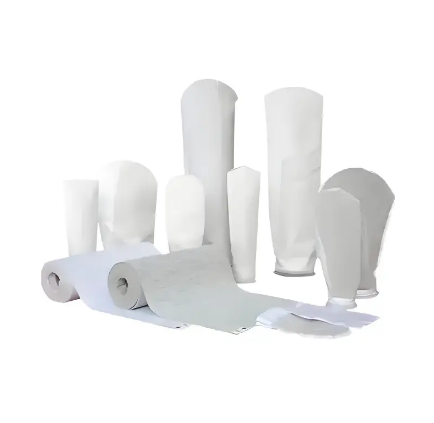
Understanding filtration terminology prevents operational disasters. Operators often misunderstand micron ratings, leading to rapid blinding and system failures.
A nominal rating indicates average pore size. A 20μm nominal bag might let larger deformable particles slip through. Soft gels simply squeeze through the pores under high pump pressure. It offers only an approximate retention rate, usually around 60% to 70%. An absolute bag guarantees 99% or higher retention at the specified micron level. Use absolute bags for high-purity applications where downstream equipment requires absolute protection.
We advise strongly against over-filtering. Choosing a tighter micron rating than necessary accelerates media blinding. It forces pumps to work harder and consume more electricity. We highly recommend adopting a strict rule for standard change-outs. Replace your bags when differential pressure reaches 15 PSID (Pounds per Square Inch Differential). Waiting longer invites media rupture and sudden system bypass.
Different structural designs handle contaminants differently. You must match the physical filtration mechanism to your specific dirt profile.
Filtration Mechanism Comparison Feature Surface Filtration (Mesh) Depth Filtration (Needle Felt) Mechanism Interception strictly at the surface level Traps particles within the tortuous media matrix Dirt-Holding Capacity Low to Moderate Very High Maintenance Often washable and reusable Single-use, disposable Best Use Case Hard, uniform particles and high flow Mixed sizes, deformable gels, heavy loads
Fluid always seeks the path of least resistance. Poor structural construction creates microscopic bypass routes. You must scrutinize seams and collars closely to ensure total system integrity.
Industry standards traditionally use a 5-thread stitch for sewn seams. They provide decent tensile strength and lower manufacturing costs. However, the sewing needle creates hundreds of tiny holes along the entire edge. High-purity applications suffer massive bypass through these tiny needle holes.
Precision ultrasonic welding offers a massively superior choice. Welded seams fuse the polymer layers together thermally. They completely eliminate thread contamination and needle holes. You avoid bypass risks entirely. Welded seams provide a much stronger physical bond under heavy stress.
The top collar dictates how well the bag seals inside the rigid housing.
Steel Rings (Galvanized/Stainless): These serve as the historical standard. They rely entirely on heavy housing lid compression to form a mechanical seal. Irregular compression often causes edge leaks.
Plastic Flanges: Engineers increasingly prefer precision plastic flanges. They feature built-in handles for easy, ergonomic removal. They utilize smooth edges to prevent dirt buildup during operation. Their specialized "snap-in" sealing mechanism actively prevents lateral bypass.
Loose media fibers migrating into your treated water cause major downstream defects. Manufacturers use special thermal finishes to prevent this shedding. Glazed finishes use pressure and heat to melt and smooth the outer surface. Singed finishes burn off loose fibers quickly via open flame. Both methods lock individual fibers tightly into the media matrix. They ensure your filtrate remains flawlessly pure.
Procurement departments often focus strictly on unit purchase price. They habitually buy the cheapest bag available on the market. This approach completely ignores the actual cost of daily operation. You must evaluate the Total Cost of Ownership (TCO) for true savings.
Cheap bags blind quickly. They require highly frequent change-outs. Every single replacement stops your production line. It forces maintenance teams into action. They must lock out pumps, drain housings, remove wet bags, and restart the system. Consider a premium multi-layer depth bag. It might cost double upfront. However, it often lasts three to four times longer. You dramatically reduce maintenance labor. You minimize extremely expensive process interruptions.
Restricted fluid flow wastes electricity constantly. High-efficiency, low-pressure-drop bags reduce the kinetic energy load on your system pumps. Pumps consume significantly less power when pushing fluid through optimized, highly porous media. This daily energy savings quickly offsets the premium bag purchase price.
High-capacity, thermally welded bags yield a significantly higher Return on Investment (ROI). They protect continuous industrial water treatment operations reliably day after day. Spending more on precision engineered media ultimately saves your facility thousands of dollars annually in hidden operational costs.
You need accurate data before calling a supplier. Vague requests lead to poor sizing, rapid blinding, and constant process failures. Follow this structured engineering approach for successful procurement.
Provide Original Equipment Manufacturers (OEMs) with specific operational details. We strongly recommend compiling the following metrics:
Fluid type: Identify the exact chemical composition and pH level.
Operating temperature: Note normal temperatures and absolute maximum thermal spikes.
Maximum flow rate: Measure this precisely in GPM or cubic meters per hour.
Viscosity: Provide centipoise (cP) values at your standard operating temperature.
Desired micron rating: Specify clearly whether you require nominal or absolute efficiency.
Ensure your selected bag physically matches your existing vessel without retrofitting. Standard industry sizes like Size 1 and Size 2 must fit perfectly into the restrainer basket. Check the housing metallurgy carefully. Carbon steel, stainless steel, and specialty alloys interact differently with certain fluids. A mismatched bag dimension causes immediate seal failure and total system bypass.
Never commit to an annual bulk supply contract blindly. We strongly recommend starting with a small batch test. Install the new bags into your current vessels. Monitor the actual PSID progression during a normal production run. Confirm the lifespan, retention rate, and flow dynamics in your real-world environment before making a final purchasing decision.
The "best" liquid filter bag perfectly balances micron precision, material compatibility, and optimal pressure drop. Your specific water treatment application heavily dictates this exact balance. Careful, methodical selection protects your downstream equipment and maintains pristine fluid purity.
Consider these final actionable steps:
Prioritize precision welded seams and absolute-rated media for all critical systems to eliminate bypass entirely.
Calculate actual Total Cost of Ownership over simple unit cost to uncover massive hidden labor and energy expenses.
Audit your current filter bag failure rates and precisely track how often operators replace them.
Contact a qualified application engineer for a comprehensive system review if you experience sudden, frequent pressure spikes.
A: The industry standard requires replacing the bag when the differential pressure reaches 15 PSID. Changing bags at this threshold prevents structural failure. It stops sudden bursts and eliminates bypass risks. Pushing beyond 15 PSID forces your pumps to consume excessive energy and damages the filter media irreparably.
A: Monofilament mesh bags can sometimes undergo washing and reuse for coarse filtration. They capture particles strictly on their surface. However, needle-felt depth filters trap particles internally within their complex fiber matrix. You must discard felt bags after use. Washing them fails to remove embedded dirt, causing immediate pressure loss and contamination.
A: Bag collapse typically occurs when you operate beyond the maximum differential pressure limits. Sudden viscosity spikes in your fluid can also overwhelm the media. Additionally, a missing or damaged stainless steel restrainer basket inside the housing leaves the bag completely unsupported against the pump pressure.
A: Liquid bags handle fluid hydrodynamics and depth-loading of wet gels. They must fit precise vessel dimensions to prevent liquid bypass. Conversely, dust collector filter bags manage high-volume air-to-cloth ratios in dry environments. They utilize pulse-jet cleaning systems. Both categories share polymers like PTFE and Polyester, but their structural engineering differs completely.


